
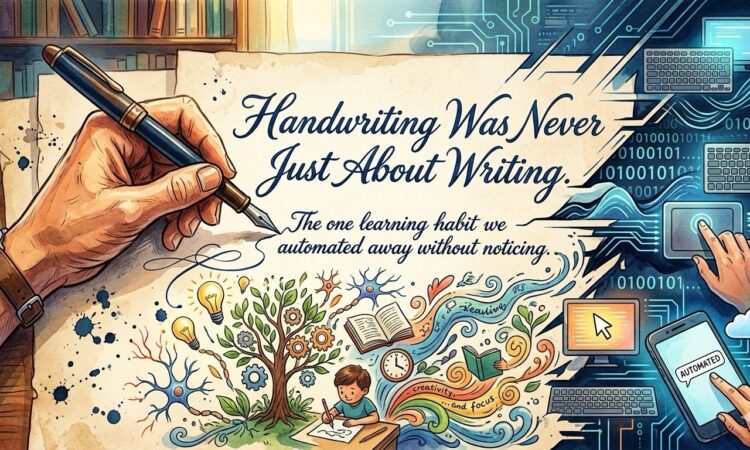
The one learning habit we automated away without noticing.
By Shruthi L
The Education System Thinker
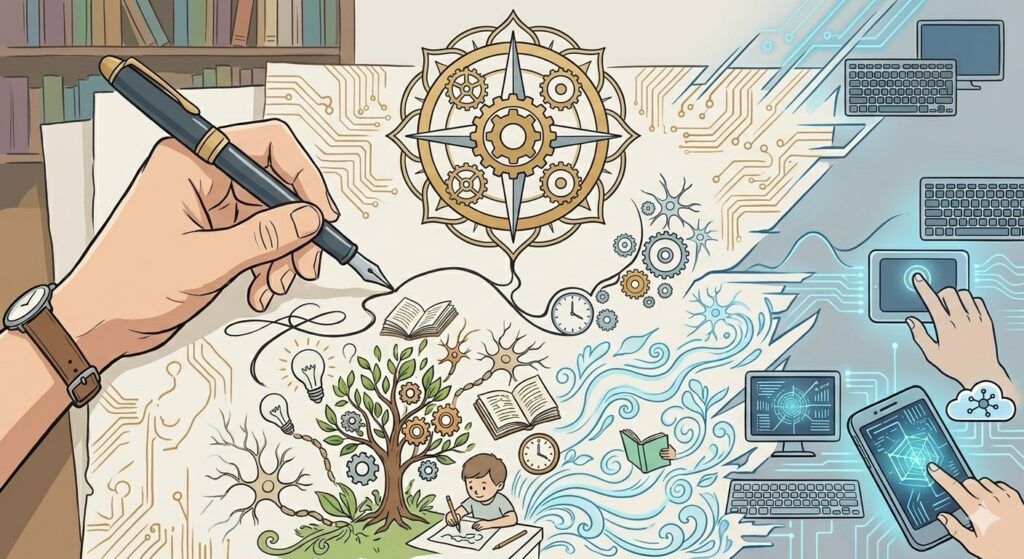
There is a skill most of us learned before we learned anything else. Before reading comprehension. Before multiplication. Before we understood what school was even for.
We learned to hold a pencil. To form a letter. To feel the resistance of a page.
It was slow. It was effortful. And for most of human history, that slowness was the point — because writing and thinking happened at the same speed. One could not race ahead of the other.
That relationship is now broken. And we may be only beginning to understand what we have lost in breaking it.
Today, students can produce words faster than they can produce thoughts. They can capture a lecture before they have understood it. They can submit an assignment before they have truly engaged with it. Speed has become the default mode of learning — and somewhere in that acceleration, the quiet work of thinking has been quietly left behind.
This is not a story about nostalgia for fountain pens and ruled notebooks. It is a story about cognition. About what happens inside the brain when a hand moves slowly across a page — and what stops happening when it no longer does.
“Writing and thinking once happened at the same speed. One could not race ahead of the other. That relationship is now broken.”
THE SCIENCE
Slower writing, deeper thinking
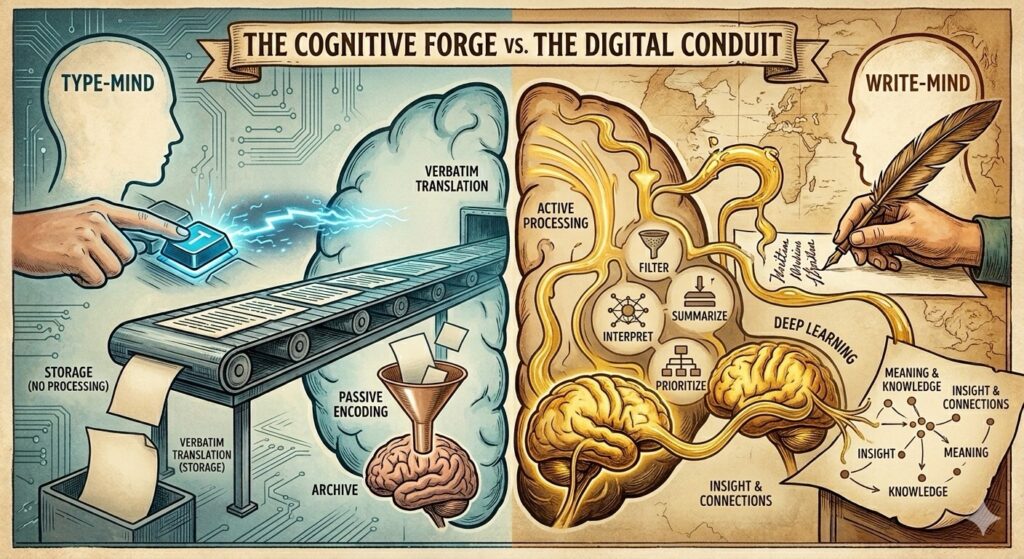
Typing allows students to capture information quickly. Handwriting forces them to engage with it. Because learners cannot usually copy every word at speaking speed, the brain must filter, summarize, interpret, and prioritize in real time — activating deeper cognitive engagement. Students are not just writing. They are thinking.
Neuroscience research consistently shows that handwriting activates broader neural pathways connected to memory, comprehension, and attention. Studies comparing both methods repeatedly find that students who write by hand retain concepts more durably — even when they capture fewer words overall. Depth of processing matters more than volume of capture.
Interestingly, handwriting is not alone in this. Drawing and painting share something with it — all three slow the hand down in ways that typing never does, and that resistance alone seems to deepen engagement. A student who sketches a concept often recalls it better than one who merely read about it. The act of making something by hand, it turns out, is also an act of remembering it.
But handwriting carries something the others do not. When we write words, language processing and motor memory activate together — each reinforcing the other in a loop that is uniquely suited to learning. It is not just the slowness that matters. It is what the brain is doing with that slowness: building meaning, not just recording it.
WHAT HANDWRITING QUIETLY TRAINS
– Identifying what information actually matters
– Reorganizing ideas in your own words
– Building associations between concepts
– Strengthening long-term recall pathways
– Sustaining focus without digital interruption
THE BIGGER PICTURE
This is not about rejecting technology

Digital platforms have improved accessibility, collaboration, and scale in ways traditional classrooms never could. Students absolutely need technological fluency for the future they are entering. But educational design becomes risky when convenience starts replacing cognition.
The tools of learning changed quickly over the last decade. Smart boards, tablets, AI-assisted tools, screen-based content delivery — classrooms transformed faster than perhaps any generation before has witnessed. What did not change, and could not, was how the brain learns. Attention, memory formation, reflection, association, deep processing — these remain what they have always been.
Not every process should be frictionless. Some friction is where learning actually happens. In a future increasingly shaped by automation, the ability to focus deeply, process meaningfully, and think independently may become one of the most important human skills a student can develop. Handwriting — slow, deliberate, personal — may still be one of the few learning processes that trains exactly that.