


~Shruthi L
Education Systems Thinker
When a child can’t sit still or stay focused, our first instinct is to ask what’s wrong with them. Maybe we should be asking what’s changed around them.

“Children just can’t focus anymore.”
I heard this recently in a school corridor — said with frustration, but underneath it, real worry. As a parent, I felt that worry too. But as someone who spends time watching classrooms and how they work, I keep coming back to a nagging question: what if we have the wrong explanation?
What if what looks like a discipline problem is actually something else entirely?
What Children Brought Back With Them
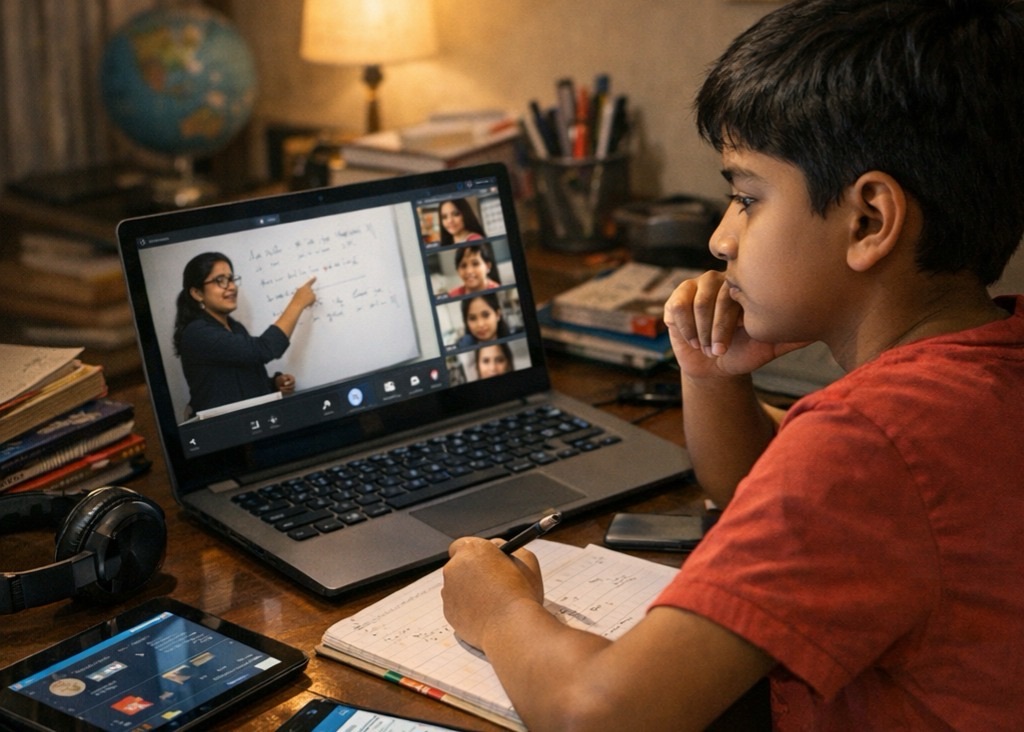
Think about what the last few years did to children. School stopped. Routines fell apart. Screens became the main window to friends, lessons, and the world. When children finally came back to classrooms, they were not the same children who had left — and that is not a criticism. It is just true.
Many came back anxious in ways they couldn’t name. Many had grown used to moving through content quickly, switching between apps, videos, and chats, getting constant feedback and stimulation.
The pandemic also interrupted something schools quietly rely on: habit formation. Regular schedules, social interaction, and structured classroom routines all help build attention and self-regulation. When those rhythms disappeared, many children lost the daily practice that strengthens these skills.
So, when the classroom returned — with its slower pace, its single task, its demand to sit and listen — it felt unfamiliar. For many children, it still does.
When we see a child staring out the window or fidgeting through a lesson, we see the behaviour. We rarely ask what their brain has been quietly trained to do over the past few years.
WHAT THEY CARRIED IN
The human weight
Broken routines. More screen time. The awkwardness of relearning how to be around people. A background hum of uncertainty and anxiety. None of these disappear when the school bell rings.
HOW THE BRAIN ADAPTED
The brain did its job — just not the job we needed.
Neuroscience consistently shows that the brain adapts to what it repeatedly practices.
Years of fast, stimulating digital environments train the brain to switch quickly between stimuli. This kind of attentional switching is efficient in a digital context, but it makes sustained focus on one slow task feel genuinely difficult.
This is not laziness. It is adaptation.
WHAT SCHOOLS STILL EXPECT
Meanwhile, most school systems have not changed much.
Packed lesson plans. Speed valued over depth. Sitting quietly treated as proof of learning. These expectations were designed for a different set of habits — habits that many children simply have not had the chance to rebuild.
Focus is not willpower

Here is something that often gets lost in these conversations: attention is not simply a matter of trying harder.
It is something the brain actually has to be built up to do — a cognitive skill that develops through practice.
Research on executive function and attention shows that sustained focus strengthens gradually when children repeatedly engage in structured tasks that require concentration, reflection, and persistence.
In other words, attention behaves much like a muscle. It grows with training.
If a child spends hours in environments where stimulation changes every few seconds
— where boredom can be escaped with a tap — the brain becomes excellent at rapid switching.
Then that same child sits in a classroom where the task is to stay with one thing for forty minutes.
The mismatch is real.
The struggle is real.
But calling it bad behaviour misses the point.
“It’s not that children won’t focus. It’s that we’ve accidentally trained them out of it — and now we’re surprised when they struggle.”
Are We Designing for It?
This is where it gets important for schools.
If attention is a skill that can be built — and research suggests it can — then the
question is not:
“How do we make children behave better?”
The question becomes:
“Have we designed classrooms that help children rebuild the ability to focus?”
In many schools, the honest answer is: not really.
We still run lessons as if attention is something children either have or don’t. We
reward the ones who sit quietly and label them focused. We worry about the ones who
can’t — and too often, we reach for labels.
But deep, sustained focus — the kind that leads to meaningful learning — grows when
children are given structured stretches of uninterrupted work, followed by real breaks.
It grows when they learn to notice when their attention drifts, and how to bring it back.
It grows when classrooms feel safe enough for the nervous system to lower its guard
and allow curiosity to take the lead.
These are not soft ideas. They are what the evidence increasingly points to.
A Different Question

That shift — from demanding a behaviour to building a skill — changes everything.
It changes what teachers do in their classrooms.
It changes how school leaders design schedules.
It changes what parents think about at home.
And it changes how we talk to children about their own struggles.
Instead of saying, “Pay attention,” we can say, “Let’s practise focusing together.”

WHERE TO START
Rebuilding attention does not require dramatic changes. Small, deliberate shifts in classroom practice can make a meaningful difference.
1. Create short blocks of distraction-free work
Design lessons that include 10–15 minutes of uninterrupted, phone-free, device-free work. Protect this time carefully. Even short periods of sustained focus help rebuild attention stamina.
2. Balance focus with genuine breaks
Attention grows best in cycles. Short, demanding tasks followed by real breaks allow the brain to reset and return with stronger concentration.
3. Redefine what attention looks like
Quiet classrooms are not always focused classrooms. Instead of measuring attention by silence or stillness, look for engagement, thinking, and effort.
4. Teach children how attention works
Help students understand attention as a skill. Talk about distraction, mind-wandering, and how to gently bring focus back to a task. When children understand their own attention, they gain control over it.
5. Give teachers space to slow down
School leaders should examine whether timetables allow teachers to prioritise depth over constant coverage. Attention cannot grow in environments that are always rushing.
6. Support healthy evening habits
Parents also play an important role. Late-night screen exposure, especially before sleep, reduces a child’s ability to concentrate the next day. Small changes in evening routines can significantly affect classroom focus.
The Uncomfortable Truth
Here is the part that is hardest to sit with.
The attention crisis in classrooms did not appear out of nowhere.
It grew from the world we built: the devices we put in children’s hands, the disruptions
we lived through during the pandemic, and the school systems that have not yet fully
adapted.
Children are not broken.
They adapted.
The brain does that.
The real question now is whether the adults around them are willing to adapt as well.
Because if we keep diagnosing this as a discipline problem, we will keep reaching for the wrong solutions: more rules, more consequences, more frustration on both sides.
And the children who are genuinely struggling — not misbehaving, but struggling — will continue to fall further behind.
What if the most important thing we could teach children right now is not a subject — but the ability to pay attention to one?
If the adults around children begin to treat attention as a skill worth rebuilding, patiently and deliberately, we may discover that the real challenge was never discipline.
It was design: the environments we create at school, the habits we shape at home, and the choices we make about how children spend their time and attention.
By
Shruthi L.
Education system thinker