

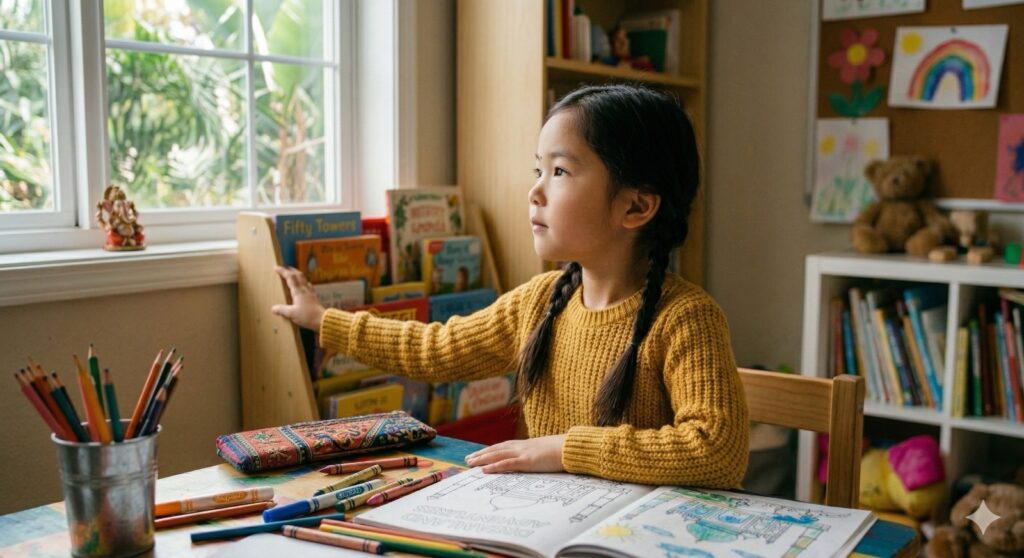
A child pausing mid-colouring — a small moment that carries a larger question.
A child pauses mid-colouring, looks up, and asks, “Is this right?”
It is an ordinary question — and yet it reflects something larger.
We spend years asking children to stay within the lines andlater expect them to think outside the box. Somewhere along the way, that transition is never quite taught. It is simply expected.
The gap becomes most visible during the long, unstructured days of summer.
Summer arrives without instruction. No school bells, no homework, no routines. For children, it begins as openness. For adults, it often brings a quieter unease.
What does one do with time that has no clear outcome?
Almost instinctively, structure returns. Days fill up — camps, classes, activities — often with the best intentions: to keep children engaged, to ensure time is “used well.”
Freedom is quickly reshaped into productivity.
Summer arrives without instruction. No school bells, no homework, no routines. For children, it begins as openness. For adults, it often brings a quieter unease.
What does one do with time that has no clear outcome?
Idleness has a purpose we rarely pause to recognise.
From the earliest stages, children are taught to follow boundaries — colour within them, write between them, stay inside them. These instructions build discipline. But over time, they begin to carry a quieter message.
At some point, being correct becomes more important than being curious.
Not explicitly — but through repetition. A child who follows is affirmed. A child who deviates is redirected. Slowly, it becomes safer to find the right answer than to question it.
Children do not begin this way. Given space, they create without hesitation. But over time, a pause appears — a glance for validation, a quiet question: “Is this, okay?”
Expression begins to pass through a filter.
What changes is not the ability to think freely, but the confidence to do so without reassurance.
Unstructured time — often dismissed as idleness — serves a different purpose. It allows thinking to unfold without direction. It is here that imagination takes shape, and children encounter something equally important: uncertainty.
And with uncertainty comes the experience of not knowing what to do next.
Increasingly, these moments are shortened.
“Do something useful.”
“Don’t waste time.”
The intention is to guide. Yet something else quietly disappears — the chance to navigate time and thought independently.
Summer makes this pattern visible. In the absence of external structure, the instinct to rebuild it becomes stronger. Days are planned. Engagement is ensured. Time is accounted for.
Adults move, often unconsciously, from being present in a child’s experience to managing it.
The question shifts — from what might emerge to what should come next.
should come next.
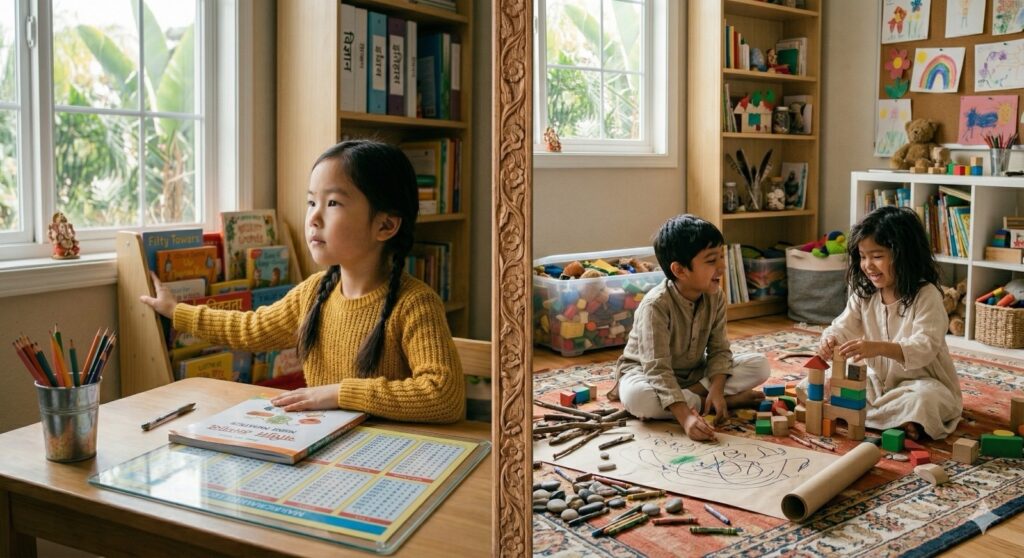
Structure is not the enemy — but the space between structures matters too.
Structure itself is not the problem. Boundaries are necessary. Creativity is often built on an understanding of form and discipline.
The challenge lies elsewhere.
Children are taught how to follow boundaries. They are less often shown when to stretch them, question them, or move beyond them.
The transition is assumed, rarely experienced.
There is another shift, less visible but increasingly present. Children today grow up surrounded by finished outcomes. Processes are shortened. Mistakes are corrected quickly. Failure, when it appears, is brief.
What becomes less familiar is not difficulty itself, but the experience of staying with it.
To not know.
To not succeed immediately.
To try without certainty.
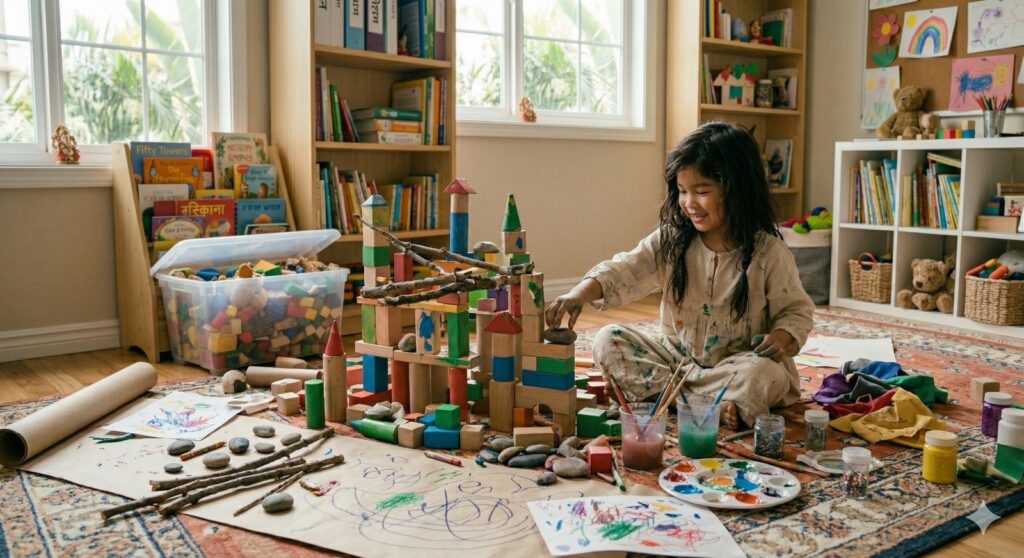
And yet, it is within these experiences that adaptability begins to take shape.
Not all thinking begins with direction.
Perhaps the challenge is not in creating structure, but in knowing when to step away from it.
A few small shifts can change how summer unfolds — not by adding more, but by holding back just enough:
Leave parts of the day unplanned, even if it feels uncomfortable at first.
Resist the urge to immediately fill boredom — it often transforms on its own.
Allow children to begin something without knowing how it will end.
Let effort sit longer than usual before stepping in to correct it.
These are not strategies in the usual sense. They are pauses — deliberate, often uneasy — where independence quietly begins.
Because not every moment of uncertainty needs resolution. Some of it simply needs time.
Summer does not need to be managed perfectly. It only needs to leave behind a few moments where a child did not ask, “Is this right?” — and continued anyway.
Perhaps the question is not whether children are capable of thinking differently.
They are.
The question is whether they are given enough moments where thinking differently is not immediately evaluated or redirected.
Not every moment needs structure. Not every hour needs intention.
Some spaces can remain undefined.
Because thinking differently is not something children begin to do when we ask it of them. It is something they learn in the moments where there is no clear instruction to follow — and no immediate answer to find.
Some spaces can remain undefined.
That is not emptiness.
That is room.
–Shruthi L
Education Systems Thinker